
Update: G.S. Proctor & Associates / Flatiron Energy feels the need or is required to have a dedicated Director of Fire Protection & Safety Christopher Groves.
Background includes battery storage safety, code compliance, emergency response, UL 9540/UL 9540A standards, and NFPA 855 battery safety standards.
The proposed Battery Energy Storage System (BESS) will be built on the existing Chalk Point Power Plant property in Aquasco, Maryland, adjacent to the town of Eagle Harbor.Technology: The project will utilize Lithium Iron Phosphate (LFP) batteries.
Capacity: Flatiron Energy’s official project website indicates a full-build capacity of up to 670.2 MW / 2,680.8 MWh, though the current application submitted to the Maryland Public Service Commission (PSC Case No. 9866) lists a capacity of 400 MW for a 4-hour duration
Timeline: The facility is anticipated to begin commercial operations in Q2, 2029.
Regulatory Violations & Project Track Record
There are no documented regulatory or legal violations attributed to Christopher Groves or Flatiron Energy in the public record. However, the developer has encountered notable community pushback and regulatory friction regarding safety, setbacks, and environmental concerns at other project sites in the Northeast: New Milford, Connecticut: Flatiron Energy officially paused and subsequently decided not to pursue a 140 MW BESS project on Aspetuck Ridge Road following heavy pushback from the New Milford Clean Water Coalition over wetlands, flooding risks, and proximity to residential zones.
Boston, Massachusetts: The company paused an indoor BESS project in the Allston-Brighton neighborhood after residents and local officials raised concerns over the facility’s tight 25-foot safety setback from nearby homes.
Somerset, Massachusetts: A proposed 168 MW / 672 MWh project (the Salt Cod project) at a former coal plant faced delays and uncertainty before the local Zoning Board of Appeals due to a lack of existing local zoning bylaws specifically regulating battery storage.
IMPORTANT MEETING TO ATTEND!! Lobbyists G.S. Proctor & Associates will give a public presentation of a proposed lithium battery storage facility sited for the Eagle Harbor-Chaulk Point Power Plant in Aquasco, Maryland, that burns highly flammable fuel oil and natural gas. Situated at the Patuxent River, this proposed lithium battery storage facility could environmentally impact Prince George’s, Calvert, Charles, and St. Mary’s Counties in the event of an emergency. Please be part of the conversation and attend their public presentation on the upcoming Wednesday of September 23rd at St. Paul’s Episcopal Church (Parish Hall) located at 13500 Westwood Rd., Brandywine, Maryland at 6:30 pm.
What appears to have been an attempt to approve and essentially sneak in this lithium battery storage facility without public knowledge is evidenced by the absence of notification to residents and property owners of the Town of Eagle Harbor and surrounding areas. No known notification from elected officials, including the Mayor and Commissioners of the Town of Eagle Harbor have been discovered to support that Eagle Harbor residents and property owners were informed, to the best of my knowledge. Recently, upon learning of the proposed lithium battery storage facility, it was the Former Mayor who immediately notified Eagle Harbor residents and property owners of the proposed lithium battery storage facility. Because impacted communities did not know of the proposed lithium battery storage facility, the Maryland Public Service Commission (PSC) is scheduled to approve the facility without opposition on October 1, 2026, unless the public becomes involved. Already the site of Maryland’s largest man-made environmental disaster, the Chaulk Point Power Plant is situated beside the predominately African American waterfront and historic Town of Eagle Harbor and Community of Cedar Haven. Eagle Harbor, Cedar Haven, and the power plant are all shared and connected by the same roadway that provides only one way in and one way out. Considering the history of uncontrollable fires caused by lithium batteries, how prudent is it to store lithium batteries on a power plant that also stores fuel oil and is connected to a natural gas pipeline, whereby people may not be able to get out in a disaster? Your voice is needed.”
To participate in the Maryland Public Service Commission (PSC) public hearing on Wednesday, September 23rd at 6:30 PM, you can either attend and speak in person or submit your written testimony electronically or by mail. The meeting will be held at St. Paul’s Episcopal Church (Parish Hall), located at 13500 Westwood Rd., Brandywine,
Maryland.Brandywine MDcom, has not came across a petition as of yet.
Eagle Harbor Maryland current safety concerns regarding flooding, oil spill,data centers and lithium battery storage.
Brandywine TB Southern Region Neighborhood Coalition Statement from their page:”
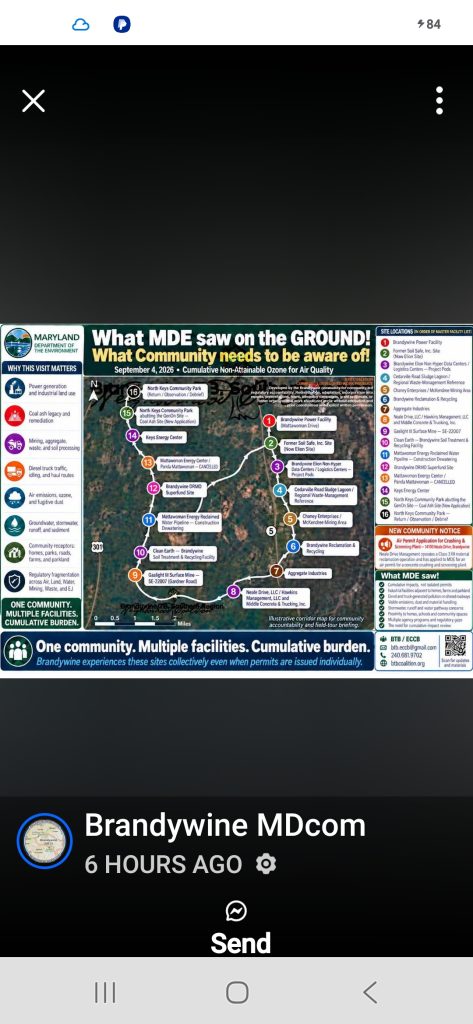
????MDE Came to Brandywine — What Our Community Needs to Know?#3 Logistics | Possible Data Center Pods ?#8 Neale Drive Concrete BatchingNeighbors,On September 4, the Maryland Department of the Environment came to Brandywine for an on-the-ground regulatory field tour of the industrial and environmental conditions our community has been raising concerns about for years. This was not a ceremonial visit. MDE was taken through the actual corridor where residents experience the cumulative impacts of power generation, mining and aggregate operations, waste and soil-processing facilities, coal-ash legacy concerns, heavy diesel-truck traffic, air emissions, stormwater and groundwater issues, and industrial activity located alongside homes, farms, roads and community spaces. The tour included 16 locations and community-impact points, allowing MDE staff to see something that individual permits do not show on paper: One community. Multiple facilities. Cumulative burden. We also highlighted a new community notice involving an air permit application for a crushing and screening plant at 14100 Neale Drive in Brandywine, adding another proposed industrial activity to a corridor already carrying substantial environmental and infrastructure impacts. Our message to MDE was straightforward: Brandywine cannot continue to be evaluated one facility, one permit and one agency program at a time. The State must begin looking at the combined impact of stationary sources, diesel traffic, mining, waste operations, water pathways, community proximity and regulatory gaps.
Local elected leadership was also invited to participate. Council Member Harrison was invited to the September 4 field tour but was not in attendance. Given the significance of these conditions to the residents he represents, his absence was noticeable. We will continue providing his office with the information developed from this process and expect meaningful engagement as the work moves forward. The field tour was only the beginning.
The next phase is accountability: documenting what MDE observed, identifying which agency programs have responsibility, establishing follow-up actions and timelines, and making sure the community can see what happens after the visit. We’re sharing our updated Site Locations / Community Awareness Map so residents can see the concentration of facilities and conditions within this one Brandywine corridor. This is why cumulative-impact review matters. What looks like separate permits to government is one lived environment to the people who live here. Please share this information with your neighbors. More updates will follow as we move from the field tour to agency response and accountability. COMMUNITY-DEVELOPED WORK PRODUCT Developed by the Brandywine community for community-led regulatory accountability. Redistribution, adaptation, incorporation into reports, presentations, tours, advocacy campaigns, grant proposals, or other organizational work should not occur without attribution and prior coordination with the originating community. BTB / ECCB Brandywine Community Accountability Initiative”
After researching the post from Noah Waters of Eagle Harbor, Maryland on G.S. Proctor & Associates, Inc. proposed lithium battery storage facility sited for the Eagle Harbor-Chaulk Point Power Plant in Aquasco, Maryland and Brandywine TB Southern Region Neighborhood Coalition reporting on Maryland Department of the Environment coming to Brandywine for an on-the-ground regulatory field tour of the industrial and environmental conditions in our community of Brandywine MDcom area. I would like to provide more information obtained by an AI search because several viewers had additional questions.
After reviewing the map and available property records more closely, with the assistance of AI, here is a more detailed report. The map does not establish three confirmed data-center pods. Item #3 refers to the Elion Logistics Park property at 14900 Elion Way, where several industrial-development parcels are being marketed. However, I have not located an official county application confirming three data centers or identifying three separate data-center addresses. Item #8 is the Neale Drive/Hawkins Management fill and recycling area—not a confirmed data-center pod. The map does not identify a third data-center location. Therefore, the accurate statement is that the Elion property has multiple industrial/logistics development sites, but three proposed data-center pods have not been independently confirmed.
## Address of site #8**Neale Drive Management / Hawkins Management****14100 Neale Drive, Brandywine, MD 20613**It is described as a **Class 3 fill-material reclamation site** accepting materials such as clean soil, asphalt and concrete. MDE also received an air-permit application for a concrete crushing and screening plant there. I found **no confirmed data-center or battery-storage application for 14100 Neale Drive**.
## Projects within approximately 25 miles of 20613 The exact distance varies depending on whether it is measured from the center of ZIP Code 20613 or by driving distance.
### 1. Chalk Point battery-storage proposal — confirmed* **Address:** 25100 Chalk Point Road, Aquasco, MD 20608* **Developer:** Flatiron Energy* **Technology:** Lithium-iron-phosphate, or LFP, batteries* **Proposed capacity:** 400 megawatts* **Location:** Existing Chalk Point power-station property* **Status:** Submitted through Maryland’s energy-storage solicitation process; still subject to regulatory and project approvals. This is the clearest confirmed large battery-storage proposal near Brandywine. [Maryland PSC project information]
### 2. Elion Logistics Park — possible future data-center location, but unconfirmed* **Address:** 14900 Elion Way, Brandywine, MD 20613* **Property:** Approximately 283-acre industrial campus with multiple separately marketed parcels.* **Approved concept:** Roughly 3.2 million square feet of industrial/warehouse development.* **Status:** The parcels are marketed for industrial and logistics development. I found **no publicly filed application confirming that any parcel will become a data center**.
### 3. Morgantown/TeraWulf data-center proposal — confirmed plan, early approval stage* **Site:** Morgantown Generating Station, Newburg, Charles County* **General address:** Crain Highway/Route 301 at the Morgantown power-plant property* **Proposal:** TeraWulf plans to develop data-center capacity incrementally, potentially reaching **1,000 MW**, while expanding power generation at the property.* **Status:** FERC authorized the power-plant sale in July 2026, but that does **not** constitute final approval to build the data center. State and Charles County approvals are still required. [Project report and FERC docket information] This property is around the edge of a 25-mile radius, depending on the measurement point.
### 4. Brightseat Tech Park at former Landover Mall — proposed but paused* **Location:** Former Landover Mall property near Brightseat Road and Landover Road* **Proposal:** Five-building hyperscale data-center campus, reportedly requiring as much as **820 MW*** **Status:** The proposal is affected by Prince George’s County’s moratorium on new hyperscale data centers. It is not approved for construction.* **Distance:** Near the outer portion of a roughly 25-mile radius from Brandywine.
## Bottom line Within approximately 25 miles of 20613, I found:* **One clearly documented lithium-battery proposal:** Chalk Point, 25100 Chalk Point Road.* **Two publicly discussed data-center proposals:** Morgantown and the former Landover Mall.* **One industrial site sometimes discussed as a possible data-center location:** Elion Logistics Park—but no confirmed data-center application.* **No evidence that #8, 14100 Neale Drive, is currently proposed for either a data center or lithium-battery storage facility.
**The Mattawoman reclaimed-water pipeline and Mattawoman Energy Center entries relate to the same cancelled Panda Mattawoman power project. They should not be counted as two current operating facilities.
The Brandywine DRMO is a confirmed eight-acre federal Superfund site. EPA reports that former military waste handling contaminated soil and groundwater, including contamination involving TCE and PCBs. Cleanup remains under Air Force responsibility and EPA oversight.
Keys Energy Center is a real operating natural-gas power plant on North Keys Road. A large former GenOn coal-ash disposal site adjoins North Keys Community Park. EPA lists the Brandywine Ash Landfill as a coal-combustion-residual site.
The map raises legitimate questions about Brandywine’s concentration of power generation, mining, soil processing, recycling, truck traffic, contaminated properties and coal-ash disposal.
? Flooding and Stormwater Runoff Flooding is a persistent and growing threat in Eagle Harbor. Coleman Creek Overflow: Heavy rains routinely overwhelm the town’s main water artery, Coleman Creek, causing it to overflow, erode its banks, and deposit massive amounts of sand and debris onto local roads and yards. Industrial Runoff: This flooding is heavily exacerbated by stormwater runoff originating from the adjacent Chalk Point property, where a legacy culvert pipe discharges water directly toward the town and the Patuxent River.
Infrastructure Strain: The town is actively using federal grants and its sustainability plan to stabilize the creek’s banks and address failing private septic systems, which risk leaking into groundwater during flood events.
?? Oil and Fuel Spill Risks While Chalk Point deactivated its coal-fired units in 2021, the site did not fully close. Ongoing Generator Operations: The plant continues to operate generators powered by natural gas and fuel oil. Because of this, the community remains downwind and downstream of active fossil fuel storage and transportation, leaving a localized risk of fuel or oil spills into the Patuxent River ecosystem.
Legacy Pollution: Eagle Harbor scores in the 79th percentile for wastewater discharge on the EPA’s Environmental Justice Index due to decades of unmonitored power plant runoff, prompting recent community-led initiatives to baseline-test tap water and soil.
?? Data Center Development Data center expansion has become a major flashpoint across Maryland, and Eagle Harbor is directly in the crosshairs.
Loss of Community Character: Prince George’s County has aggressively explored data center development. Mayor Waters and local activists have strongly opposed this, citing that the immense physical size, high-voltage transmission lines, and constant ambient noise would “kill the town’s character” and ruin its natural quiet. Resource Strain: Residents share statewide concerns over the massive amounts of electricity and water required to cool these facilities. This local pushback mirrors a broader trend: as of late 2026, thirteen Maryland counties have placed moratoriums or bans on data centers while waiting for a highly anticipated state environmental impact report.
? Lithium Battery Energy Storage Systems (BESS) To support the grid and potential data centers, energy companies are proposing massive Lithium-ion battery storage facilities near Eagle Harbor.
Fire and Toxic Smoke Hazards: Residents have expressed severe concern over the risk of lithium battery fires. Unlike standard fires, lithium-ion thermal runaway events are notoriously difficult to extinguish, can burn for days, and release highly toxic chemical smoke. Contamination: A primary concern is that the water or special fluids used by emergency responders to cool a battery fire would carry toxic heavy metals and chemical runoff directly into Eagle Harbor’s vulnerable groundwater and the Patuxent River.
Emergency Preparedness: Local advocates note that rural fire departments lack the specialized training, heavy equipment, and resources required to handle a utility-scale battery emergency.
https://www.ridgetoreefs.org/eagle-harbor-home
https://darrp.noaa.gov/oil-spills/chalk-point
https://www.townofeagleharborincmd.org/
About the Author